
Supporting Voices
Sudanese Drama in Wartime: From Embodying Tragedy to Crafting Hope
Amsterdam – October 8, 2026 – Dabanga Radio: "Drama artists must broaden the circles of hope through their work..." The post Sudanese Drama in Wartime: From Embodying Tragedy to Crafting Hope appeared first on Dabanga Radio TV Online.
Radio Dabanga (Arabic) October 8, 2026Published 1 views
Source:Radio Dabanga (Arabic)
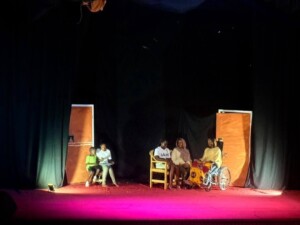
Amsterdam – October 8, 2026 – Dabanga Radio: "Drama artists must broaden the circles of hope through their work, and affirm that the Sudanese people have managed to liberate themselves from despair." This was stated by writer and playwright Rabie Yousef Al-Hassan in an interview with Dabanga Radio, in response to a question about the role of drama artists amidst the current war. He emphasized that the narratives and details of the ongoing tragedy and the sadness enveloping the public mood must be countered with a discourse of resistance; because, by the nature of things, there is no oppressor without a resister. He explained that as much as the war has manifested in various forms of violence and daily oppression facing citizens whose lives have been turned upside down, there have also been stories of resistance that succeeded in lighting areas of hope, thereby liberating Sudanese from despair. He added that this is the role drama must play in the current circumstance, avoiding sinking into the restoration of tragic discourse in favor of adopting a discourse of resistance and hope. Dramatic Equivalent and Documenting Tragedy Director Rabie Yousef asserted that he does not reject or neglect the documentary dimension of drama, which must document—even on a metaphorical or hypothetical level—the tragedies, massacres, and details everyone knows about this war. He stressed the necessity of finding a creative, hypothetical, and metaphorical dramatic equivalent to reflect these tragedies and this resistance. He noted that the drama artist—like all members of the Sudanese people and other professionals—finds himself trapped between choices of affiliation with one side or the other in this war to provide protection for himself and his family, and the realities of daily living needs. In this context, principles are indivisible, and every decision-maker or person taking a stand must realize that there is a price to be paid. Rabie Yousef added that in light of sharp polarizations and real risks facing those who take positions, some can take a public stance with one of the war's parties because they believe they are in the right, while others cannot, due to their circumstances, take a clear position. He confirmed his belief in the necessity of confronting "false consciousness"—as he put it—regardless of the entity issuing such confused and misleading discourse. He explained that taking positions should not be from a political vantage point, but from a professional one that provides the opportunity to be objective and view the scene, the situation, and the current historical moment in a holistic and comprehensive manner, without abandoning one's responsibilities toward oneself first, one's family, and one's country. He stressed that these three levels must be a single package, because the salvation of the individual and their family is inseparable from the salvation of the entire homeland. He added that the opportunity for artists and creators to live a dignified life through which they can provide good contributions to their country is limited when they are alone, but professional and union organizations make their voices heard and provide them with the opportunity to communicate with international and regional institutions that can provide protection, support, and platforms for them. He pointed out that drama artists must express their opinion in support of other voices calling for an end to the war. Field Experiences of Resilience For his part, writer, poet, and playwright Afif Ismail believes that drama artists—like the entire Sudanese people—have presented bright examples of cohesion and cooperation, citing the African proverb: "When a tree leans, it leans on its sister." Dabanga Radio spoke to him during a visit to Amsterdam, the Netherlands, asking him about drama, drama artists, and their role during these difficult times of war. In his interview with Dabanga Radio, Professor Afif Ismail provided several positive examples that embody persistence, resilience, and continued giving even under the darkest circumstances like the war we are witnessing now. He cited "Yasser Ali," one of the founders of the "Al-Jamam" theater group, which was established in the early nineties. Afif added that Yasser Ali returned to his hometown of Al-Hasahisa a month after the war began and formed a group called "Hajwa," which moved between kindergartens, schools, and shelter centers before the Rapid Support Forces entered Al-Hasahisa and Al-Jazirah state. His activity stopped until they left Al-Jazirah, after which he resumed his theatrical work and currently moved to "Ombada," where he lives and continues his contributions. Displacement Journeys and Continued Theatrical Giving The second model cited by Afif Ismail is the "Laboratory Theater Troupe," which was also established in the nineties inside Kober Sanitarium to support inmates, at a time when music and drama therapy were still experimental. The troupe was headed by Adel Ali Al-Hassan Malik, who was displaced after the war from Khartoum to Wad Madani, and then to Kassala after the RSF entered Madani, where he continued his theatrical activity. When conditions became difficult, he moved to Cairo, where he continued his theatrical work. The third example recounted by Professor Afif Ismail is Mohammed Ahmed Al-Filabi, who left Khartoum after the war broke out, returning to his village of "Al-Juweir" in the Northern State, where he continued his theatrical and awareness-raising activities, then moved from there to Port Sudan, where he continued his theatrical and environmental work. Afif Ismail affirmed that theater and theater artists never stopped and continued to work and produce. He gave examples of creators and theater artists abroad, such as Professor Yahya Fadlallah and Mohammed Kober, who produced a text titled "Waswas" written by Al-Rashid Ahmed Issa, which was performed in Hamilton and Toronto, Canada. They were later hosted in the "Quddamna Al-Sabah" cultural forum with critic Professor Abdul Jabbar Abdullah to talk about this inspiring experience. He also cited Professor Mohammed Taroos in the Netherlands, who has continued to present his work through social media platforms since the period preceding the fall of the Bashir regime. "Margin Theater" and the History of Sudanese Resistance Professor Afif Ismail affirmed that theater is an act of resistance, noting that the history of Sudanese theater began during the colonial era to resist and affirm the sense of national self, followed by successive military dictatorships ruling Sudan. Since then, theater was divided into two: one loyal to the authority, supported and provided with all means by the state, and what is called "Margin Theater"—before politicians co-opted the term, according to him. He explained that the margin theater is the real, effective theater that belongs to the people, and that the majority of actors and actresses we see in the arena now are graduates of the schools of the margin. Afif Ismail confirmed that the act of resistance in theater will continue and will not stop, pointing to the COVID-19 pandemic experience, which revealed to people the possibility of artistic work and during which singing and theatrical experiences were created in all areas of the arts. This is an inspiring thing that enables us to continue working in resistance theater at the diaspora level.
Radio Dabanga (Arabic)اراء وتحليلات
Share
Comments
No comments yet. Be the first to share your thoughts.
Subscribe to our newsletter
Get a summary of the latest news and analysis delivered to your inbox.