
Economy (Citizen's Condition)
Fuel crisis exacerbates the suffering of returnees to Khartoum as a former minister diagnoses the causes of the crisis
Khartoum - October 12, 2026 - Dabanga Radio. The transportation and transit crisis in the capital, Khartoum, has reached a breaking point following...
Radio Dabanga (Arabic) October 12, 2026Published 1 views
Source:Radio Dabanga (Arabic)
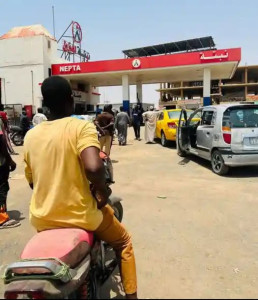
Khartoum - October 12, 2026 - Dabanga Radio. The transportation and transit crisis in the capital, Khartoum, has reached a breaking point following a record jump in petroleum product prices, with the price of a gallon of gasoline touching the 60,000 Sudanese pounds mark, amid growing fears of the repercussions on market activity and the return of citizens. Abdullah Khaled, a Khartoum resident, told Dabanga Radio that the insane rise in fuel prices has led to a noticeable decline in transport activity and a near-paralysis on the capital's streets. He explained that this crisis has cast a negative shadow over various vital public and private sectors, doubling the daily suffering of citizens. Khaled explained that the escalation of the crisis coincides with the return of thousands of citizens to Khartoum after hard years of war, noting that the city lacks infrastructure ready for transport, which requires urgent intervention and comprehensive development of the transport sector to facilitate citizens' movement and enable them to conduct their daily business in markets and streets. Khaled emphasized that the continuation of the fuel crisis and such high costs significantly complicates humanitarian and living conditions, necessitating immediate review and urgent measures to address the crisis and alleviate the heavy burdens on citizens. In the states of Kassala, Red Sea, and Gezira, the fuel crisis continues noticeably, with eyewitnesses pointing to long queues at fuel stations and a scarcity of transportation. The state of Kassala issued a decision to increase the price of a gallon of diesel to about 44,000 pounds. Key Challenges: For his part, former Minister of Energy, Mohamed Abdullah Mahmoud Bashir, told Dabanga Radio that the main challenges in providing fuel lie in how to secure foreign currency and how to regulate the import process. In his remarks to Dabanga Radio, he criticized what he described as confusion in regulating the import process, especially the requirement for importing companies to deposit 200 kilograms of gold as a guarantee. This amount is considered very large and constitutes frozen assets, which limits the ability of many Sudanese companies to meet this condition. Instead, he proposed obligating importing and distributing companies to maintain a strategic fuel reserve sufficient for one to three months to meet the country's needs and emergencies. He believes that the mentioned gold should be used to purchase fuel as a strategic reserve and called for opening the import door to all qualified companies to encourage competition, with the Sudanese Petroleum Corporation regulating this process and overseeing the distribution of quantities. The former Energy Minister confirmed that the Sudanese Petroleum Corporation has the exclusive legal right to import and distribute, but it can grant import rights to specialized companies under its supervision and control. Regarding the formation of the Supreme Petroleum Council, the former minister affirmed that the law provides for the formation of a 'Petroleum Affairs Council' rather than a 'Supreme Petroleum Council.' He believes that the optimal structure for the Petroleum Affairs Council should be chaired by the Prime Minister, with membership from the Ministers of Energy, Finance, and Industry, the Governor of the Central Bank of Sudan, and three Sudanese experts in the field of energy and oil. He criticized the current formation of the council, describing it as 'distorted' and lacking representation from vital ministries such as the Ministry of Finance, which plays an important role in the financial aspects of the council.
Radio Dabanga (Arabic)الأخبارالخبر الرئيسيالصفحة الرئيسيةسياسةعناوين الأخبار
Share
Comments
No comments yet. Be the first to share your thoughts.
Subscribe to our newsletter
Get a summary of the latest news and analysis delivered to your inbox.