
Humanitarian Crisis
Human Rights Council adopts resolution to extend mandate of fact-finding mission in Sudan for one year
Amsterdam- October 5, 2026- Radio Dabanga The United Nations Human Rights Council adopted today, Monday... The post Human Rights Council adopts resolution to extend mandate of fact-finding mission in Sudan for one year appeared first on Dabanga Radio TV Online.
Radio Dabanga (Arabic) October 5, 2026Published 1 views
Source:Radio Dabanga (Arabic)
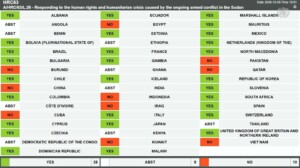
Amsterdam- October 5, 2026- Radio Dabanga The United Nations Human Rights Council adopted today, Monday, by majority vote, a resolution to extend the mandate of the 'Independent International Fact-Finding Mission for the Sudan' for one additional year. The Council adopted the resolution with 28 countries in favor, 10 against, and 9 abstentions. Prominent countries that voted against the resolution include China, Cuba, and Vietnam; among Islamic nations, Pakistan and Indonesia; from the Arab Group, Qatar, Kuwait, Iraq, and Egypt; alongside Burundi from African nations. Most African countries abstained from voting, including Ethiopia, while Gambia, South Africa, Malawi, and Mauritius voted in favor of the resolution. European Union member states, South American nations, and Asian countries, with the exception of India and Thailand, voted in favor. The resolution issued by the UN Human Rights Council (at its 63rd session for 2026) under reference (A/HRC/63/L.26), presented by a broad international group (including France, Albania, Germany, Switzerland, the United Kingdom, and others) titled 'Responding to the human rights and humanitarian crisis caused by the ongoing armed conflict in Sudan'—which Radio Dabanga has reviewed—demands an immediate and unconditional ceasefire and the initiation of a comprehensive civilian-led political transition. The resolution emphasized the full and transparent implementation of the 'Jeddah Declaration to Protect Civilians' and the facilitation of unhindered humanitarian aid access across borders and frontlines (including extending the opening of the Adre border crossing). The resolution also stressed Sudan's sovereignty, independence, and territorial integrity, and the categorical rejection of establishing any parallel governing authorities or entities in areas controlled by the Rapid Support Forces. Mission Role The resolution noted the pivotal role of the International Criminal Court in investigating crimes, calling for the mission to expand the scope of the Court's investigation to include all of Sudan, not just Darfur. It affirmed the mission's commitment to provide oral updates and comprehensive reports to the Human Rights Council and the United Nations in future sessions. The resolution stressed the collection and preservation of evidence to prevent impunity and hold all involved individuals accountable along the chain of command. The resolution requested the UN Secretary-General to provide all necessary resources, expertise, and logistical systems to support the mission, and called on all parties to the conflict, countries, and relevant actors to cooperate fully with the fact-finding mission and provide it with the necessary information and documents. Violations and Humanitarian Disaster The resolution pointed to the scale of the humanitarian disaster in Sudan, where more than 33 million people require aid, with 11.3 million people displaced internally and 4.6 million seeking refuge in neighboring countries. It issued a severe warning of acute famine and food insecurity affecting more than 19.5 million people (41% of the population), and the use of starvation as a weapon of war. The resolution condemned the continued fighting and the violations committed by the Sudanese Armed Forces and the Rapid Support Forces, some of which amount to war crimes and crimes against humanity, including indiscriminate attacks by aircraft and drones, the targeting of infrastructure and hospitals, arbitrary detention, and extrajudicial killings. The resolution also condemned the events in El Fasher and El Obeid, characterized by siege, ethnic-based actions, criminal violence, and severe sexual violence in and around El Fasher (which indicate signs of genocide), while warning against the repetition of such large-scale crimes in the El Obeid region in Kordofan. Condemnation of Sexual Violence and External Interference The resolution expressed grave concern over the prevalence of sexual violence and gender-based violations, the abduction of women and girls, and the forced recruitment of children. It condemned targeting and external interference, noting attacks and assaults directed against humanitarian, health, and media workers, human rights defenders, and Emergency Response Room groups. It also condemned external financial and military interventions, mercenaries, and the supply of weapons and drones to both parties.
Radio Dabanga (Arabic)الأخبارالخبر الرئيسيالصفحة الرئيسيةسياسةشريط الأخبارعناوين الأخبار
Share
Comments
No comments yet. Be the first to share your thoughts.
Subscribe to our newsletter
Get a summary of the latest news and analysis delivered to your inbox.