
Sudan in the World
Extension of Sanctions Regime on Sudan for 60 Days: A U.S. Retreat or a Diplomatic Respite?
Amsterdam: October 9, 2026 – Radio Dabanga. Massad Boulos, senior advisor to the U.S. President for Arab and African affairs, said that the United States' decision to support the technical extension of the UN Security Council resolution on the arms embargo imposed on Darfur until December 11 came after consultations with the Quad and international allies.
Radio Dabanga (Arabic) October 9, 2026Published 1 views
Source:Radio Dabanga (Arabic)
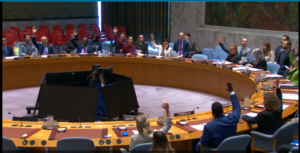
Amsterdam: October 9, 2026 – Radio Dabanga. Massad Boulos, senior advisor to the U.S. President for Arab and African affairs, stated that the U.S. decision to support a technical extension of the Security Council resolution on the arms embargo imposed on Darfur until December 11 followed consultations with the Quad, international allies, and Security Council members. In a post on the 'X' platform, Boulos explained that this decision is not a retreat from his country's resolve, but is intended to create space for diplomatic efforts and initiatives aimed at reaching a humanitarian truce and a permanent ceasefire, as a prelude to a credible transition toward a civilian government. He also emphasized Washington's commitment to strengthening the arms embargo to protect civilians and address the threat of drones and advanced weaponry. He stressed the need to halt external military support to the warring parties and to prevent the use of neighboring countries' territories as platforms for fueling the conflict, noting President Trump’s call for an immediate end to violence and the facilitation of unhindered humanitarian access. Diplomatic Defeat: Commenting on Boulos's post, Cameron Hudson, a former White House official, said that Washington had suffered a series of humiliating diplomatic defeats over the past two weeks in its efforts to force Sudanese authorities to sign a ceasefire agreement—an agreement those authorities were not prepared to sign, and for which field conditions were not favorable. He stated on 'X' that the campaign to expand the arms embargo was poorly planned and executed, and never had a chance of gathering the necessary votes, as it did not even receive the support of a single African state within the Security Council. Despite intense U.S. efforts in diplomatic pressure and public relations, the attempt failed miserably, leading to what he described as a disgraceful withdrawal. He viewed the events as a low point in the history of U.S. diplomacy toward Sudan, revealing the weakness of a diplomatic team lacking specialized professional experience. Hudson criticized the decision to withhold a visa from Lieutenant General Al-Burhan as a means to pressure him into signing a ceasefire, calling it evidence of the poor planning and execution of current U.S. diplomacy. He explained that the reactions—whether public statements from Saudi Arabia or private ones from numerous other parties questioning the utility and purpose of the 'Quad'—represent another blow to American diplomacy. He noted that as long as the U.S. is unable to exercise a leadership role in the Security Council or convince its closest partners of its approach, we are witnessing the unintended (or perhaps intended) consequences of a foreign policy based on 'America First.' He called on Washington to conduct a series of consultations including Riyadh, Ankara, and Doha (having already heard Cairo's perspective), attempt to rebuild trust with Khartoum's closest allies, and then head to Khartoum to meet with the leadership alongside civilians, politicians, and representatives of non-governmental organizations. Sudanese Welcome: The Permanent Mission of Sudan to the United Nations in New York welcomed the Security Council's adoption yesterday of the technical extension of measures under Resolution 1591 for the second time, maintaining them in their current geographic scope and content for 60 days. In a statement, the mission explained that the problem facing the 1591 regime throughout the past period lies not in its narrow geographic scope, but in the lack of the necessary political will to enforce it. The mission noted that Sudan, the Panel of Experts established under Resolution 1591, and credible international reports have provided information and evidence regarding the continuous flow of weapons, ammunition, drones, and mercenaries to the Rapid Support Forces via neighboring African countries and the desert; yet, these flows have continued, pointing to the Security Council's inability to ensure actual compliance with its resolutions. The mission stressed that failures in implementation cannot be remedied by expansion, and that violations of an embargo are not addressed by imposing a broader embargo on the state affected by it. It stated that expanding the measures to include the entire territory was not based on an objective assessment of security and stability needs in Sudan, while expressing skepticism regarding the motives behind the UAE's stance. Opposition to Expanding the Embargo: The mission emphasized that Sudan strongly opposes any non-objective attempt to expand the 1591 regime to cover its entire territory, arguing that extending an arms embargo to all of Sudan would blur the fundamental legal and institutional distinction between the state and its national armed forces on one hand, and militias and armed groups on the other. It stated that the Sudanese Armed Forces are a national institution of the state, tasked with protecting its sovereignty, territorial integrity, and people, and have the right to procure weapons legitimately from any willing source; they cannot be treated as an armed group outside the state's authority. It indicated that the core of the problem is the weak implementation of the existing 1591 system, not its geographic scope. The mission continued that a comprehensive arms embargo would necessitate prior authorization and licensing for all exports of weapons and dual-use military equipment, and would ban conventional weapons and dual-use items, including national arms manufacturing and the activities of the Defense Industry System. The embargo would also include goods whose sales revenue could be bartered for weapons, and would restrict access to arms and ammunition, effectively meaning the army would be barred from obtaining offensive or defensive equipment, in addition to banning military and paramilitary vehicles, equipment, spare parts, and maintenance.
Radio Dabanga (Arabic)الأخبارالخبر الرئيسيالصفحة الرئيسيةسياسةعناوين الأخبار
Share
Comments
No comments yet. Be the first to share your thoughts.
Subscribe to our newsletter
Get a summary of the latest news and analysis delivered to your inbox.