
Sudan in the World
Political Analyst: Developments in Ethiopia Could Make the Sudan War 'More Regional'
Amsterdam – September 24, 2026 – Radio Dabanga Tension has escalated in Ethiopia’s Tigray region... The post Political Analyst: Developments in Ethiopia Could Make the Sudan War 'More Regional' appeared first on Dabanga Radio TV Online.
Radio Dabanga (Arabic) September 24, 2026Published 1 views
Source:Radio Dabanga (Arabic)
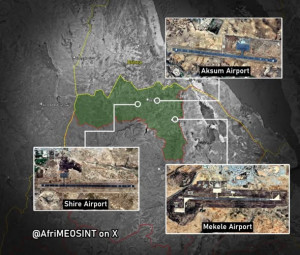
Amsterdam – September 24, 2026 – Radio Dabanga Tension has escalated in Ethiopia’s Tigray region, which borders Sudan, after the Tigray People's Liberation Front (TPLF) took control of the airport in Mekelle, the regional capital, and halted flights between the Ethiopian capital, Addis Ababa, and the airports of Mekelle, Axum, and Shire. This comes amid intensifying fighting in several regions following the formation of a coalition of seven armed groups against the federal government in Addis Ababa, raising concerns about the impact of these conditions on Sudan. In an interview with Radio Dabanga, journalist and political analyst Khaled Mohamed Taha states that any major Ethiopian escalation could make the Sudanese war more regional and less containable within Sudanese borders. Khaled emphasizes that these developments are far more dangerous than they appear for Sudan, especially since eastern Sudan itself is not politically or militarily stable. He expects that if the war in Tigray expands, Al-Fashaga could return to the forefront of the conflict, as well as the southern Blue Nile region. This may be the most dangerous issue for Sudan now, because the Ethiopian crisis comes at a moment of extreme sensitivity on the Sudanese-Ethiopian border. Khaled believes it is not necessarily the case that Ethiopia would attack Sudan, but rather that the greater risk is that the border will turn into a proxy war zone—meaning that the conflicting Sudanese and Ethiopian parties use the border, peripheral areas, local communities, and logistical corridors to serve their internal wars. Thus, Sudan would effectively become surrounded by a turbulent Ethiopian front while fighting its own internal war. An Important Shift He considers the developments of the last few days to be an important shift in the nature of the Ethiopian crisis, as it is no longer just a return of tension between Abiy Ahmed's government and the TPLF, but has begun to take the form of an armed intersection between the crises of multiple regions. He pointed out three interconnected developments that should be read together: the seizure of Mekelle airport by Tigrayan forces, the announcement of an alliance of seven armed groups against the federal government, and the growing overlap between the Ethiopian crisis, the Sudanese war, and the Ethiopian-Sudanese border. After months of clashes and drone strikes between federal and Tigrayan forces, TPLF forces took control of Alula Aba Nega Airport in Mekelle at dawn on September 23, after removing or neutralizing the federal police stationed there. Consequently, Ethiopian Airlines suspended its flights to Mekelle and Axum. He called for not treating the takeover of the airport as merely a limited military operation; militarily, the airport could become significant if the confrontation expands and supply and air transport operations become part of the conflict. He adds that the event represents a transition from a phase of mutual political and military pressure to an attempt to impose new facts on the ground. Nature of the Alliance Journalist and political analyst Khaled Mohamed Taha stressed that the importance of the seven-group coalition extends geographically from Tigray and Amhara in the north to Oromia, Benishangul-Gumuz, and the Somali region in the center and south. Khaled explained that the alliance does not bring together ideologically similar groups, but is primarily united by opposition to the central government and Abiy Ahmed's political project, which makes the coalition different from any traditional military alliance. At the same time, he pointed out a clear weakness: these groups have deep differences over land, borders, the federal system, the shape of the Ethiopian state, and the future of the regions. This means that while the alliance may be effective in exerting pressure on the center, it is not necessarily cohesive enough to produce a unified political alternative. He added: 'In general, one must be cautious of assuming that these groups will wage a joint and coordinated war at the same time; a political declaration is one thing, and the existence of a joint operations command, logistical capabilities, communications, and unified funding is another.' Share articleThe post Political Analyst: Developments in Ethiopia Could Make the Sudan War 'More Regional' appeared first on Dabanga Radio TV Online.
Radio Dabanga (Arabic)الأخبارالخبر الرئيسيالصفحة الرئيسيةسياسةشريط الأخبارعناوين الأخبار
Share
Comments
No comments yet. Be the first to share your thoughts.
Subscribe to our newsletter
Get a summary of the latest news and analysis delivered to your inbox.