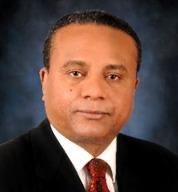
Our Response to the Commentary of Dr. Amin Hamid Zain Al-Abidin
Our response to the commentary of Dr. Amin Hamid Zain Al-Abidin regarding our reply to his critique of the thought of Mahmoud Mohamed Taha in his book: Contemporary Islam and the Challenge of Modernity (1-4) by Dr. Abdallah Al-Faki Al-Bashir. 'As for Dr. Mustafa Mahmoud, he brought mediocre merchandise, and it passed to consumers who do not know how to distinguish... This is one reason. The second reason is: (The foreigner complex)... for we, the Sudanese, for as long as we have been afflicted by humiliation, have lost confidence in ourselves, and we thought that goodness does not come from ourselves, nor from our fellow citizens, but rather that goodness always comes from beyond the borders of our country... This is the other reason.' Mahmoud Mohamed Taha, April 4, 1970. The post Our Response to the Commentary of Dr. Amin Hamid Zain Al-Abidin appeared first on Sudanile.
Our response to the commentary of Dr. Amin Hamid Zain Al-Abidin regarding our reply to his critique of the thought of Mahmoud Mohamed Taha in his book: Contemporary Islam and the Challenge of Modernity (1-4) by Dr. Abdallah Al-Faki Al-Bashir. 'As for Dr. Mustafa Mahmoud, he brought mediocre merchandise, and it passed to consumers who do not know how to distinguish... This is one reason. The second reason is: (The foreigner complex)... for we, the Sudanese, for as long as we have been afflicted by humiliation, have lost confidence in ourselves, and we thought that goodness does not come from ourselves, nor from our fellow citizens, but rather that goodness always comes from beyond the borders of our country... This is the other reason.' Mahmoud Mohamed Taha, April 4, 1970. Dr. Amin Hamid Zain Al-Abidin commented, in an article published in three parts, on our response to his critique of Mahmoud Mohamed Taha's thought in his book, Contemporary Islam and the Challenge of Modernity (2025). Our response, titled 'The Weakness of Sudanese Writings on the Thought of Mahmoud Mohamed Taha: The Book Contemporary Islam and the Challenge of Modernity (2025) by Amin Hamid Zain Al-Abidin as a Model,' had been published in nine series, each divided into three to five parts, with some series reaching eight parts and a total word count of (57,558 words). These series were published between August 7 and September 1, 2026, through the websites of 'Sudanile,' 'Al-Rakoba,' 'Hiwar Mutamaddin,' and others. I am currently working on collecting these series and publishing them in a book of the same title, while expanding the scope of the project to include other writings on the thought of Mahmoud Mohamed Taha. I had clarified in the final episode that the project 'The Weakness of Sudanese Writings on the Thought of Mahmoud Mohamed Taha' does not end with the conclusion of the episodes critiquing Dr. Amin's book, but rather begins from them another phase of observation, examination, documentation, verification, and study; a study that does not target individuals, but addresses the phenomenon, and does not stem from a desire to win, but from the necessity of restoring the conditions for responsible intellectual and scientific dialogue. As for Dr. Amin's commentary, it appeared in three parts under the title 'A Commentary on the Articles of Dr. Abdallah Al-Bashir Regarding the Critique of Mahmoud Mohamed Taha's Thought in My Book Contemporary Islam and the Challenge of Modernity' (6,782 words), and was published during the first half of October 2026. I have reviewed these episodes via the 'Sudanile' and 'Hiwar Mutamaddin' websites. Hence, our commentary on his commentary comes as a completion of the critical dialogue regarding the critique of Mahmoud Mohamed Taha's thought that Dr. Amin presented in his book, the discussion raised by our response to him, and the issues his commentary raised that deserve examination, scrutiny, and clarification. This commentary also comes in the context of the broader project of monitoring and studying Sudanese writings on the thought of Mahmoud Mohamed Taha, with the necessary precise documentation, critical reading of texts, and questioning of methods and arguments, away from personalization, and in a way that allows the reader to form their position based on knowledge and scientific examination. This commentary will focus on discussing the fundamental issues addressed by Dr. Amin in his commentary, by returning to the points of disagreement in reading and interpreting the thought of Mahmoud Mohamed Taha, examining the arguments he relied upon in his response to our articles, and the extent of their consistency with the original texts and evidence we presented. We will also address the critical issues that Dr. Amin overlooked, which we raised in our response, and which he did not pause at in his commentary, ignoring them as if they never existed, especially regarding his way of dealing with the texts of Mahmoud Mohamed Taha, such as inserting a word into the texts or cutting texts out of their contexts, which may lead to loading them with connotations that do not align with their original contexts, or employing them as evidence for claims that those texts, in their full context, do not prove. We will devote special attention to the issue of Sufism, regarding its place in the thought of Mahmoud Mohamed Taha, the nature of his position on it, how Dr. Amin addressed this issue, and the accuracy of his reading of the relevant texts. We will also discuss what requires clarification or correction in Dr. Amin's presentation of our positions and arguments, distinguishing between legitimate disagreement in perspectives and divergence in understanding and interpreting texts, and issues that can be verified by referring to original sources and evidence and comparing them in their contexts. The purpose of this commentary is not to prolong the argument for its own sake, or to suffice with countering judgments with counter-judgments, but to contribute to an intellectual discussion that seeks accuracy and fairness, and makes texts, arguments, and evidence the basis for dialogue. Reading the thought of Mahmoud Mohamed Taha requires dealing with his texts in their contexts, distinguishing between what they explicitly say and what might be inferred from them, and subjecting different interpretations to examination and discussion. This method will help in a deeper understanding of that thought, and allow the reader to form their position based on knowledge, documentation, and critical examination.